<?xml version="1.0" encoding="utf-8"?><feed xmlns="http://www.w3.org/2005/Atom" ><generator uri="https://jekyllrb.com/" version="3.10.0">Jekyll</generator><link href="https://bryonmiller.github.io/feed.xml" rel="self" type="application/atom+xml" /><link href="https://bryonmiller.github.io/" rel="alternate" type="text/html" /><updated>2026-08-13T16:13:52+00:00</updated><id>https://bryonmiller.github.io/feed.xml</id><title type="html">Bryon’s Blog</title><subtitle>A blog by Bryon Miller</subtitle><entry><title type="html">Flesh vs Spirit: Spiritual Dissonance</title><link href="https://bryonmiller.github.io/uncategorised/2017/08/12/flesh-vs-spirit-spiritual-dissonance.html" rel="alternate" type="text/html" title="Flesh vs Spirit: Spiritual Dissonance" /><published>2017-08-12T22:43:34+00:00</published><updated>2017-08-12T22:43:34+00:00</updated><id>https://bryonmiller.github.io/uncategorised/2017/08/12/flesh-vs-spirit-spiritual-dissonance</id><content type="html" xml:base="https://bryonmiller.github.io/uncategorised/2017/08/12/flesh-vs-spirit-spiritual-dissonance.html"><![CDATA[<p>I’ve been reading about cognitive dissonance lately-I know, I know…I’m a nerd-and it has made me start thinking about the role it plays in the spiritual life of a Christian. If you aren’t familiar with the theory of cognitive dissonance don’t worry. I’ll go through the basics before I explain what I have dubbed (probably not original content) “spiritual dissonance.”</p>

<h2 id="cognitive-dissonance">Cognitive Dissonance</h2>

<p>According to the state of having inconsistent thoughts, beliefs, or attitudes, especially as relating to behavioral decisions and attitude change. The key word here is “inconsistent.” Often you can easily change that word to “contradictory” or “conflicting.” Basically what is happening is that a person’s mind is housing two opposing thoughts and this often distresses them. This leads to them developing a new belief to reconcile these conflicting thoughts.</p>

<h3 id="example">Example</h3>

<p>A magic trick where a magician levitates in front of a crowd and someone moves a hula hoop over/under his body to show there are no strings or platforms there. A woman watching the trick has the belief that magic does not exist and/or can be explained by logic. While watching, her eyes tell her that an act of magic is taking place right in front of her. At that point in time, she is mentally/emotionally (possibly even physically) distressed because only one of the two beliefs can be true.
The next step in this process is to either reject one of the beliefs (whether through denial or proving one to be false) or to develop a new belief to reconcile the two. She could reject this by saying to herself, “That must be a trick hula hoop” or “maybe he found a way to levitate with powerful magnets.” Otherwise, she could create a new thought such as, “My eyes are playing tricks on me. This is just an illusion.”
Most of us have had a similar experience. It can be very uncomfortable and, if the illusionist is talented enough, we can truly be at a loss. People experiencing grief go through cognitive dissonance in the first stage: denial. They hold the belief that they can not lose whatever has been lost and at the same time their senses are telling them that they have indeed lost the person or thing in question.</p>

<h2 id="spiritual-dissonance">Spiritual Dissonance</h2>

<p>Now let’s relate this to the life of a Christian and specifically to their spiritual life.</p>

<h3 id="romans-7-nasb">Romans 7 (NASB)</h3>

<blockquote>
  <p>14 For we know that the Law is spiritual, but I am of flesh, sold into bondage to sin. 15 For what I am doing, I do not understand; for I am not practicing what I would like to do, but I am doing the very thing I hate. 16 But if I do the very thing I do not want to do, I agree with the Law, confessing that the Law is good. 17 So now, no longer am I the one doing it, but sin which dwells in me. 18 For I know that nothing good dwells in me, that is, in my flesh; for the willing is present in me, but the doing of the good is not. 19 For the good that I want, I do not do, but I practice the very evil that I do not want. 20 But if I am doing the very thing I do not want, I am no longer the one doing it, but sin which dwells in me.
21 I find then the principle that evil is present in me, the one who wants to do good. 22 For I joyfully concur with the law of God in the inner man, 23 but I see a different law in the members of my body, waging war against the law of my mind and making me a prisoner of the law of sin which is in my members. 24 Wretched man that I am! Who will set me free from the body of this death? 25 Thanks be to God through Jesus Christ our Lord! So then, on the one hand I myself with my mind am serving the law of God, but on the other, with my flesh the law of sin.</p>
</blockquote>

<p>If you’ve attended church for a year or two or if you’ve spent some time studying the book of Romans, chances are you have heard of this passage. This passage may be titled something like “Conflict of Two Natures” or “Flesh vs Spirit.” Now, this war between good and evil is nothing new, but something interested is happening here. Typically when we see good and evil competing with each other it just happens to be two clearly separated individuals. Here we see the war taking place within one man. I could go on and on about the things Paul teaches us here, but I want to skip ahead to the last two verses I quoted.
In verse 24 we see distress similar to that of someone experiencing cognitive dissonance. In verse 25 we can see why. Paul says, “…on the one hand I myself with my mind am serving the law of God, but on the other, with my flesh the law of sin.” What stands out to me here is that he says ‘with my mind.’ Previously he put it this way, “the good that I want, I do not do, but I practice the very evil that I do not want.” It sounds to me like Paul’s spirit is telling him to do the law of God while his flesh is telling him to do the law of sin.
Now I don’t know about you, but I know what this guy is talking about! Paul talks about this conflict again in his letter to the Church in Corinth.</p>

<h3 id="1-corinthians-2">1 Corinthians 2</h3>

<blockquote>
  <p>14But a natural man does not accept the things of the Spirit of God, for they are foolishness to him; and he cannot understand them, because they are spiritually appraised. 15But he who is spiritual appraises all things, yet he himself is appraised by no one. 16For who has known the mind of the Lord, that he will instruct Him? But we have the mind of Christ.</p>
</blockquote>

<p>The thoughts of the natural man and the thoughts of the Spirit of God are at war with each other within the same person. This is not only distressing but can be downright depressing if you are without Christ. This brings us the last step of cognitive dissonance: reconciliation. However, this reconciliation is so much greater than what we see in other areas of cognitive dissonance.
You see, Jesus Christ died for us so that we could know the truth and be set free. (John 8:32) He died for us so that we could overcome death and have abundant life. (John 10:10) In the process, he has enabled to “have the mind of Christ.” Having this mind essentially allows us to eliminate our “spiritual dissonance” by replacing our conflicting beliefs with His truth.</p>

<h2 id="conclusion">Conclusion</h2>

<p>I’ll wrap up with two statements.</p>

<ol>
  <li>If you are in the category of people who don’t have the mind of Christ and you haven’t experience the peace that “passes/transcends understanding”, then this is for you. I’ve experienced the distress that comes from being confused about right and wrong, truth and lies. It is miserable. There is a way out of that. The Bible is true and God doesn’t want you to be confused.</li>
  <li>Maybe you have the mind of Christ, but just like Paul and I, you still have moments where the “natural man” or “the flesh” rears its ugly head. In these moments you will no doubt experience what I’ve been talking about here. Let me remind you that Jesus Christ died so that you don’t have to fight that fight. We don’t have to struggle with that confusion and distress anymore. Listen to the voice of truth and allow him to reconcile you to the Father.</li>
</ol>]]></content><author><name>bmreverb</name></author><category term="Uncategorised" /><category term="cognitive dissonance" /><category term="faith" /><category term="psychology" /><category term="romans 7" /><summary type="html"><![CDATA[I’ve been reading about cognitive dissonance lately-I know, I know…I’m a nerd-and it has made me start thinking about the role it plays in the spiritual life of a Christian. If you aren’t familiar with the theory of cognitive dissonance don’t worry. I’ll go through the basics before I explain what I have dubbed (probably not original content) “spiritual dissonance.”]]></summary></entry><entry><title type="html">Finished: Codecademy JavaScript and FCC Zipline</title><link href="https://bryonmiller.github.io/uncategorised/2015/10/13/finished-codecademy-javascript-and-fcc-zipline.html" rel="alternate" type="text/html" title="Finished: Codecademy JavaScript and FCC Zipline" /><published>2015-10-13T22:15:03+00:00</published><updated>2015-10-13T22:15:03+00:00</updated><id>https://bryonmiller.github.io/uncategorised/2015/10/13/finished-codecademy-javascript-and-fcc-zipline</id><content type="html" xml:base="https://bryonmiller.github.io/uncategorised/2015/10/13/finished-codecademy-javascript-and-fcc-zipline.html"><![CDATA[<p><a href="http://blog.bryonmiller.com/wp-content/uploads/2015/10/Screenshot-2015-10-13-22.01.14-e1444792215849.png"><img src="http://blog.bryonmiller.com/wp-content/uploads/2015/10/Screenshot-2015-10-13-22.01.14-e1444792215849-300x172.png" alt="Screenshot 2015-10-13 22.01.14" /></a>
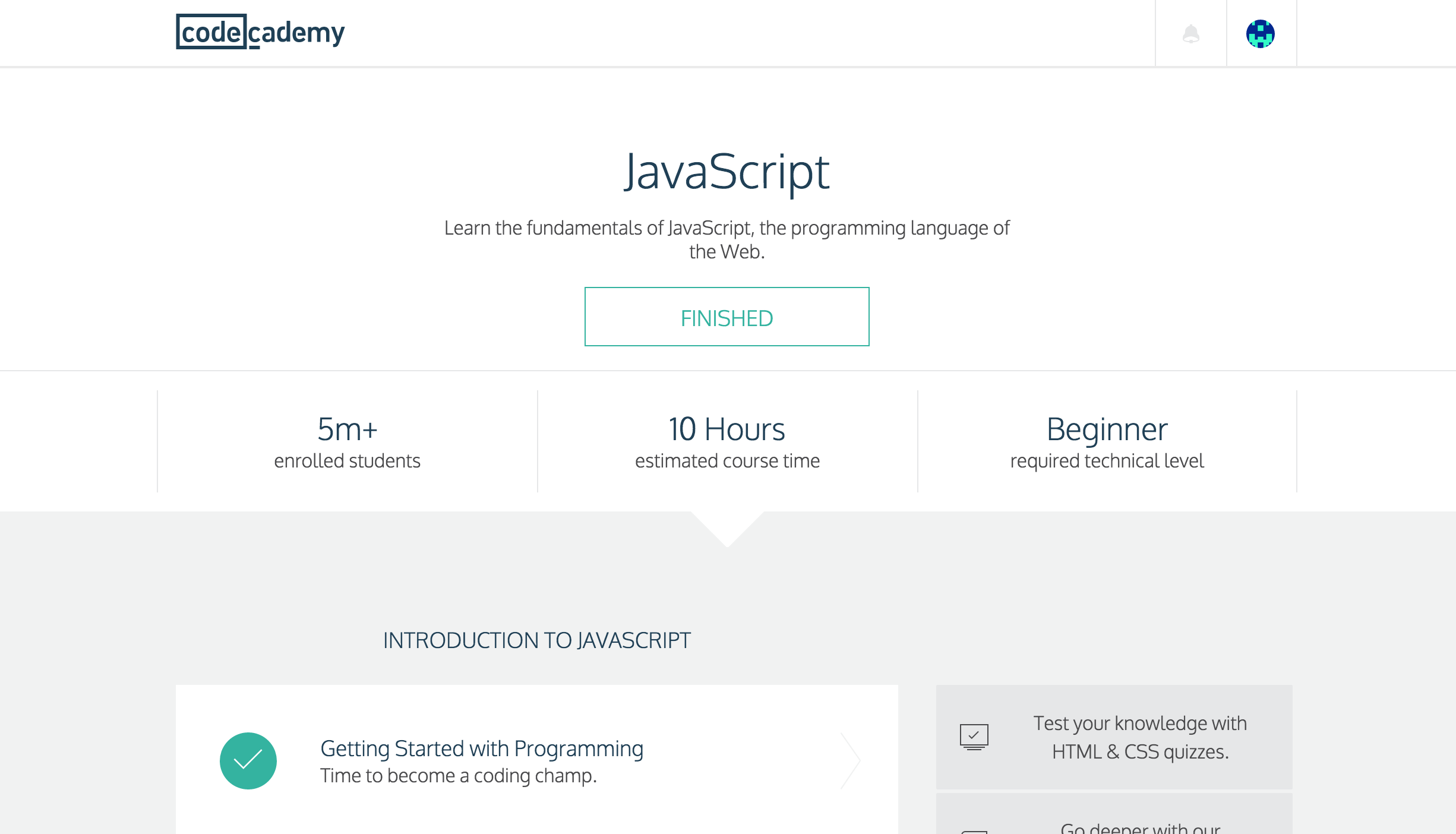
I finished the JavaScript portion of Codecademy. I had been taking my time and putting a lot of extra time into Free Code Camp, but I decided to finish it up. Now I have started the PHP section. I want to share some of what I have learned through this blog, but I haven’t been able to make time for it yet. Hopefully, I will be able to back track in the future and share some of the things I learned.
On another note, I finished my first Zipline on Free Code Camp. I will be sharing more about this in the future as well. I can tell that Free Code Camp is going to help me create a strong portfolio. I’m looking forward to that. Now, I’m off to finish some Linux homework!
Bryon</p>

<h2 id="comments">Comments</h2>

<h3 id="matt--2016-01-28-094020">Matt — 2016-01-28 09:40:20</h3>

<p>type: <code class="language-plaintext highlighter-rouge">comment</code>; approved: <code class="language-plaintext highlighter-rouge">1</code></p>

<p>Good luck with FCC, I just started this week. I finished all of Codecademy’s free material and it seemed like the next logical step.</p>

<h3 id="chrinstine--2016-09-16-052738">Chrinstine — 2016-09-16 05:27:38</h3>

<p>type: <code class="language-plaintext highlighter-rouge">comment</code>; approved: <code class="language-plaintext highlighter-rouge">1</code></p>

<p>Woah! I’m really loving the template/theme of this site.
It’s simple, yet effective. A lot of times it’s very difficult to get that “perfect balance” between usability and visual appearance.
I must say you’ve done a fantastic job with this. In addition, the blog
loads extremely fast for me on Safari. Outstanding Blog!
Chrinstine</p>]]></content><author><name>bmreverb</name></author><category term="Uncategorised" /><category term="Codecademy" /><category term="Free Code Camp" /><category term="JavaScript" /><summary type="html"><![CDATA[I finished the JavaScript portion of Codecademy. I had been taking my time and putting a lot of extra time into Free Code Camp, but I decided to finish it up. Now I have started the PHP section. I want to share some of what I have learned through this blog, but I haven’t been able to make time for it yet. Hopefully, I will be able to back track in the future and share some of the things I learned. On another note, I finished my first Zipline on Free Code Camp. I will be sharing more about this in the future as well. I can tell that Free Code Camp is going to help me create a strong portfolio. I’m looking forward to that. Now, I’m off to finish some Linux homework! Bryon]]></summary></entry><entry><title type="html">itsBeenAWhile.js: An Update</title><link href="https://bryonmiller.github.io/uncategorised/2015/08/31/itsbeenawhile-js.html" rel="alternate" type="text/html" title="itsBeenAWhile.js: An Update" /><published>2015-08-31T22:07:16+00:00</published><updated>2015-08-31T22:07:16+00:00</updated><id>https://bryonmiller.github.io/uncategorised/2015/08/31/itsbeenawhile-js</id><content type="html" xml:base="https://bryonmiller.github.io/uncategorised/2015/08/31/itsbeenawhile-js.html"><![CDATA[<p>If you thought this was a post about a new JavaScript framework, it isn’t. If you are learning JavaScript and thought this, then kudos to you for recognizing the iconic camelCase writing and the ‘.js’ extension. Unfortunately, it was just a clever way to start out this brief post updating you on my progress. It has been a while since I have posted on here (work has been crazy busy), but I’m still hard at it.</p>

<h2 id="javascript-progress">JavaScript Progress</h2>

<p>I am still progressing, albeit slowly, through Free Code Camp and Codecademy’s JavaScript track. I am actually working on a small portfolio piece as well. It uses everything I’ve learned so far, except for Python. It also involved Clash of Clans for all you Supercell fans out there. I will post more about it later. I actually have considered posting a series of posts on how I made each piece. Stay tuned.</p>

<h2 id="something-new">Something New</h2>

<p>The last note I will make here is something I just started last week. I am auditing a Linux course at my workplace (Northeast Alabama Community College) this semester. We can audit one class per semester for free and this one looked like a good one. The course covers bash which is great. It will also prepare me for the certification Linux+ CompTIA certification. That should come in handy down the road.</p>

<h2 id="so-thats-it">So that’s it…</h2>

<p>Hopefully, now that things have slowed down a little at work, I can post more frequently. No promises, but I’ll try to add some new stuff here soon. Thanks for reading. Keep coding!</p>

<p>Bryon</p>]]></content><author><name>bmreverb</name></author><category term="Uncategorised" /><summary type="html"><![CDATA[If you thought this was a post about a new JavaScript framework, it isn’t. If you are learning JavaScript and thought this, then kudos to you for recognizing the iconic camelCase writing and the ‘.js’ extension. Unfortunately, it was just a clever way to start out this brief post updating you on my progress. It has been a while since I have posted on here (work has been crazy busy), but I’m still hard at it.]]></summary></entry><entry><title type="html">Fun with jQuery Animations: My Current Top 5</title><link href="https://bryonmiller.github.io/uncategorised/2015/08/11/jquery-fun.html" rel="alternate" type="text/html" title="Fun with jQuery Animations: My Current Top 5" /><published>2015-08-11T21:40:55+00:00</published><updated>2015-08-11T21:40:55+00:00</updated><id>https://bryonmiller.github.io/uncategorised/2015/08/11/jquery-fun</id><content type="html" xml:base="https://bryonmiller.github.io/uncategorised/2015/08/11/jquery-fun.html"><![CDATA[<p>I just finished up the jQuery section of Free Code Camp and I tinkered around with it afterwards. If you have just started coding or have been using JavaScript for awhile but haven’t used jQuery, I recommend checking it out. (You can do so here: <a href="http://www.jquery.com">jQuery.com</a>.) It is super powerful and super simple. To of my favorite things. I thought I would share a Top 5 list of my current favorite animations that I have learned.</p>

<h2 id="5-animate">5. animate()</h2>

<p>I feel like I’m cheating with this one, so I’ll put it at number five. Basically, this will allow you to move, resize, etc. an element over a set amount of time. Imagine the possibilities. This is widely used, but I found it incredibly useful. Therefore, I included it here. Here is the link to the documentation: <a href="http://api.jquery.com/animate/">animate()</a>.</p>

<h2 id="4-fadetoggle">4. fadeToggle()</h2>

<p>A little fancier that the typical fadeIn() or fadeOut(), fadeToggle() does just what you think it does. It will fade an object in and out as it is triggered. Simple, but awesome! Here is a link to some documentation on how to use it to its fullest: <a href="http://www.w3schools.com/jquery/eff_fadetoggle.asp">fadeToggle()</a>.</p>

<h2 id="3-animated-text-and-icon-menu">3. Animated Text and Icon Menu</h2>

<p>This one is more complex and requires code other than jQuery. It makes some elements slide out, changes and animates the background color of the item, and then slides the elements back in with a different color. Pretty cool. Check it out here: <a href="http://tympanus.net/codrops/2011/07/12/animated-text-and-icon-menu/">Animate Text and Icon Menu</a>.</p>

<h2 id="2-explode">2. explode()</h2>

<p>Am I immature for putting this at number two? Who doesn’t love a good explosion? This is simple and easy to use. It does what is says and nothing more. Take your divs and blow them up! Here is some useful documentation: <a href="https://api.jqueryui.com/explode-effect/">explode()</a>.</p>

<h2 id="1-circulate">1. circulate()</h2>

<p>Seriously, this one is so much fun. It essentially makes objects ‘circulate’ is circles and ellipses. I can’t do it justice with a text explanation. Navigate to this site to see the magic: <a href="https://css-tricks.com/examples/Circulate/">circulate()</a>.</p>

<h2 id="conclusion">Conclusion</h2>

<p>There are so many other excellent jQuery animations. Some are simple and easy to use. Others require much more information and calculations to optimize them. Some create beautiful menus and others make text come alive. The best thing to do is to explore them all. Check them out and let me know your favorites.
<a href="http://www.jquery.com/"><img src="http://blog.bryonmiller.com/wp-content/uploads/2015/08/jquery-mark-light.gif" alt="jquery-mark-light" /></a></p>]]></content><author><name>bmreverb</name></author><category term="Uncategorised" /><category term="animation" /><category term="JavaScript" /><category term="jquery" /><summary type="html"><![CDATA[I just finished up the jQuery section of Free Code Camp and I tinkered around with it afterwards. If you have just started coding or have been using JavaScript for awhile but haven’t used jQuery, I recommend checking it out. (You can do so here: jQuery.com.) It is super powerful and super simple. To of my favorite things. I thought I would share a Top 5 list of my current favorite animations that I have learned.]]></summary></entry><entry><title type="html">Quora Question: Python code correction</title><link href="https://bryonmiller.github.io/uncategorised/2015/08/04/quora-question-python.html" rel="alternate" type="text/html" title="Quora Question: Python code correction" /><published>2015-08-04T21:37:05+00:00</published><updated>2015-08-04T21:37:05+00:00</updated><id>https://bryonmiller.github.io/uncategorised/2015/08/04/quora-question-python</id><content type="html" xml:base="https://bryonmiller.github.io/uncategorised/2015/08/04/quora-question-python.html"><![CDATA[<p>If you aren’t using Quora, you should be. It is a great community of helpful people. Lately, I have been corresponding with another Quora member who is learning to code. He is learning Python and really doing well. I may share some more of our conversations at a later date, but today I just want to share the one we had yesterday. It was about a some code he had written that wasn’t working the way he wanted.</p>

<h2 id="the-problem-code">The Problem Code</h2>

<p>Here is his code.</p>

<div class="language-plaintext highlighter-rouge"><div class="highlight"><pre class="highlight"><code>from sys import argv

script, letter_file = argv

string_let='abcdefghijklmnopqrstuvwxyz'
list_of_letters = list(string_let)

f = open(letter_file)
output = f.read()

wf = open(letter_file, 'w')

def write_func():
    for j in range(26):
        for i in list_of_letters:
            wf.write(i)

write_func()
wf.close()

raw_input('Press to read contents of %r' % letter_file)

print output
</code></pre></div></div>

<p>His goal was to write every letter from a string to a file. Then, open/read that file and print the contents. He was getting it to write the contents (although it was writing it 26 times), but when he would try to print the file, it would print a blank line. After a little debugging, and cleaning up the code a bit, I was able to fix the issue. Can you tell what is wrong here?</p>

<h2 id="the-correction-and-solution">The Correction and Solution</h2>

<p>Here is the corrected code that I sent him back.
[spoiler title=’My Code’ style=’default’ collapse_link=’true’]</p>

<div class="language-plaintext highlighter-rouge"><div class="highlight"><pre class="highlight"><code>from sys import argv

script, letter_file = argv

string_let='abcdefghijklmnopqrstuvwxyz'
list_of_letters = list(string_let)

f = open(letter_file)

wf = open(letter_file, 'w')

def write_func():
    for i in list_of_letters:
        wf.write(i)

write_func()
wf.close()

raw_input('Press  to read contents of %r' % letter_file)

output = f.read()

print output

raw_input('Staying open...')
</code></pre></div></div>

<p>[/spoiler]
Remember, with this code we are printing the variable ‘output’ to the terminal. We defined ‘output’ as ‘f.read()’. The issue occurs because of <em>when</em> it was defined in the original. What is in the file when you call the ‘.read()’ function in the original code? Nothing at all. Therefore, output = “” and will show this when printed.
As I said, the issue was all about <em>when</em> output was assigned a value. When we move the assignment to a point where the file has been written and closed, the new contents of the file are assigned to outputs. Then, when we print it, we get the results we want. The fix is easy is that easy. Move the definition of ‘output’ to a point in the code after the content has been written to the file and the file is closed. Tada!</p>

<h2 id="whats-going-on-here-and-why">What’s Going on Here and Why?</h2>

<p>Assigning values that can change can be tricky. We have something like the following scenario:</p>

<div class="language-plaintext highlighter-rouge"><div class="highlight"><pre class="highlight"><code>y = 1

x = y

def change_x(n):
    x = n
    return x

y = 2

change_x(y)

print x
</code></pre></div></div>

<p>What happens here can be very confusing to anyone new to programming. Notice that throughout the code, x = y. The magic happens when we reassign y and give it the value of ‘2’. If we were to print x immediately after ‘y = 2’, what would print? (Hint: The answer isn’t ‘2’.) Even though the value of y changes, the value of x does not until we run the change_x (y) function.
Doesn’t seem right, but it is. For more information on this weird happening, read this: <a href="http://anh.cs.luc.edu/python/hands-on/3.1/handsonHtml/graphics.html#more-on-mutable-and-immutable-types">Mutable and Immutable Types</a>. For more information on plain old assignment, read this: <a href="http://anh.cs.luc.edu/python/hands-on/3.1/handsonHtml/variables.html">Variables and Assignment</a>.
Play around with these concepts and you’ll get the hang of it pretty quick. Happy coding!
Bryon</p>]]></content><author><name>bmreverb</name></author><category term="Uncategorised" /><category term="coding" /><category term="python" /><category term="quora" /><summary type="html"><![CDATA[If you aren’t using Quora, you should be. It is a great community of helpful people. Lately, I have been corresponding with another Quora member who is learning to code. He is learning Python and really doing well. I may share some more of our conversations at a later date, but today I just want to share the one we had yesterday. It was about a some code he had written that wasn’t working the way he wanted.]]></summary></entry><entry><title type="html">Quora Question: If programming languages are only tools…</title><link href="https://bryonmiller.github.io/uncategorised/2015/07/27/quora-question-if-programming-languages-are-only-tools.html" rel="alternate" type="text/html" title="Quora Question: If programming languages are only tools…" /><published>2015-07-27T22:32:38+00:00</published><updated>2015-07-27T22:32:38+00:00</updated><id>https://bryonmiller.github.io/uncategorised/2015/07/27/quora-question-if-programming-languages-are-only-tools</id><content type="html" xml:base="https://bryonmiller.github.io/uncategorised/2015/07/27/quora-question-if-programming-languages-are-only-tools.html"><![CDATA[<p>I wanted to share a question I answered on Quora.com today. It was interesting and I thought I ended up giving a decent answer. Here is the question:</p>
<blockquote>
  <p><a href="http://www.quora.com/If-programming-languages-are-only-tools-in-programming-then-how-does-one-really-start-learning-programming">If programming languages are only tools in programming, then how does one really start learning programming?</a></p>
</blockquote>

<p>That kind of baffled me when I first read it, but I started thinking about it and answered. Here is the link to my response: <a href="http://www.quora.com/If-programming-languages-are-only-tools-in-programming-then-how-does-one-really-start-learning-programming/answer/Bryon-Miller-2">My Answer</a>. You can also read the response in this post below. Let me know what you think. (I was a little rushed, so I apologize if it seems spastic or isn’t clear.)</p>

<h2 id="the-answer">The Answer</h2>

<p>[caption id=”attachment_61” align=”alignnone” width=”300”]<a href="https://en.wikipedia.org/wiki/Tool#/media/File:20060513_toolbox.jpg"><img src="http://blog.bryonmiller.com/wp-content/uploads/2015/07/20060513_toolbox-300x225.jpg" alt="20060513_toolbox" /></a> Just like we use tools for hobbies or careers such as carpentry, languages serve as tools for programmers.[/caption]</p>

<p>Think of other hobbies or careers that involve tools. Take carpentry for example: A good carpenter has several tools he must use to build things. His skill with his tools allow him to create a superior product. The tools he uses may enable him to create a better product or possibly create the product more efficiently. Sometimes a particular tool is worthless for a task. A hammer is no good when you need a screwdriver.
Now compare this to programming. Languages are the tools the programmer used to ‘build’ their code. The more skilled you are with various languages and how they apply to what you are building, the better product you can build and the quicker you can do so. Lastly, all languages are different and no one language is the best at everything.
To use this analogy to address your question more directly, learning languages (tools) is essential to learning how to program. I would go a step further though  and say that knowledge of program structure is also very important. A carpenter has to be aware of how to build things out of various types of materials, when to use which tools, steps necessary to build a product, and have a mental or literal blueprint of what he is building. Programming is no different. Learning about general forms such as variables, loops, arrays, classes, etc. are universal to most languages. Knowing the steps to building basic applications or forms is also essential to efficiently writing quality code. Finally, and perhaps most importantly, being able to create and/or interpret a mental or literal blueprint for your program is an important part of learning to program.
If you want to do something other than learn a programming language right now I have the following advice:</p>
<ol>
  <li>Consider why you don’t want to learn a language. This is an absolute requirement of programming. No tools = no progress. If you don’t like it, you won’t make it.</li>
  <li>Study something related to programming such as mathematics, data structures, algorithms, etc. This will help when learning languages and applying what you know to actual projects.</li>
  <li>Spend time writing code, rather than just reading about how to do it. Some of my best learning comes from just sitting down and working on something. See how far what you know will take you. Then, when you see something you don’t know that is holding you back, go learn it! That will give you the motivation to learn more of a language.
I hope this helps answer your questions. Programming is all about communicating with a machine via their languages. To learn to program is to learn to speak the language. Terms, syntax, context, etc. and how to use all of these to communicate more effectively.</li>
</ol>

<h2 id="conclusion">Conclusion</h2>

<p>This question challenged me to really think about what programming is and how multidisciplinary it can be. Languages are required and proficiency with them greatly increases your coding abilities. However, there are other things you have to know. Logic, math, data structures, etc. They all play their part. In the end, languages are the ultimate tools. As a result, they are where we should focus. Luckily, when you really practice your coding while learning a language, you tend to pick up the other disciplines along the way.
Bryon</p>]]></content><author><name>bmreverb</name></author><category term="Uncategorised" /><category term="coding" /><category term="languages" /><category term="python" /><category term="quora" /><summary type="html"><![CDATA[I wanted to share a question I answered on Quora.com today. It was interesting and I thought I ended up giving a decent answer. Here is the question: If programming languages are only tools in programming, then how does one really start learning programming?]]></summary></entry><entry><title type="html">Recursive JavaScript: Fibonacci</title><link href="https://bryonmiller.github.io/uncategorised/2015/07/25/recursive-javascript-fibonacci.html" rel="alternate" type="text/html" title="Recursive JavaScript: Fibonacci" /><published>2015-07-25T15:56:59+00:00</published><updated>2015-07-25T15:56:59+00:00</updated><id>https://bryonmiller.github.io/uncategorised/2015/07/25/recursive-javascript-fibonacci</id><content type="html" xml:base="https://bryonmiller.github.io/uncategorised/2015/07/25/recursive-javascript-fibonacci.html"><![CDATA[<p>I have been struggling through the idea of recursion this week, particularly when it comes to the code for the Fibonacci sequence. I’m not sure why this baffled me (the iterative version took me a minute to grasp, but nothing like this), but it really had me confused last night. After a few articles last night, writing things out on a piece of paper, and one phenomenal YouTube video…<strong>I GOT IT!</strong> I want to share some info about it with you as well.
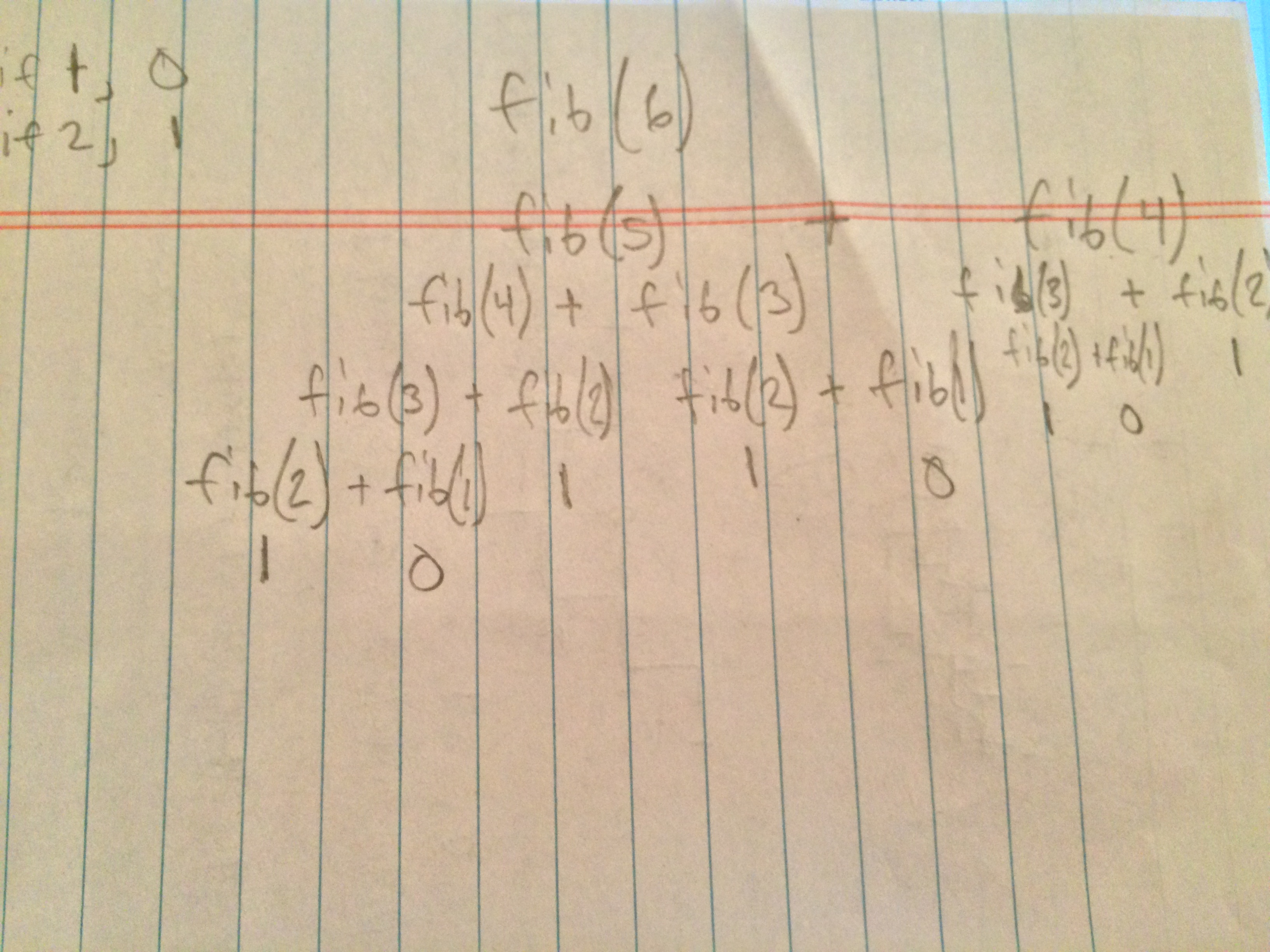
[caption id=”attachment_50” align=”alignnone” width=”300”]<a href="http://blog.bryonmiller.com/wp-content/uploads/2015/07/IMG_0803-2.jpg"><img src="http://blog.bryonmiller.com/wp-content/uploads/2015/07/IMG_0803-2-300x225.jpg" alt="Recursive Fibonacci" /></a> Working out the Fibonacci function via recursion by hand.[/caption]</p>

<h2 id="what-is-recursion">What is Recursion</h2>

<p>If you aren’t familiar with recursion, it is essentially a using a function to call on itself a necessary number of times in an effort to solve a problem. Wikipedia defines it as such:</p>
<blockquote>
  <p><strong>Recursion</strong> in <a href="https://en.wikipedia.org/wiki/Computer_science" title="Computer science">computer science</a> is a method where the solution to a problem depends on solutions to smaller instances of the same problem (as opposed to <a href="https://en.wikipedia.org/wiki/Iteration#Computing" title="Iteration">iteration</a>).<a href="https://en.wikipedia.org/wiki/Recursion_(computer_science)#cite_note-1">[1]</a> The approach can be applied to many types of problems, and <a href="https://en.wikipedia.org/wiki/Recursion" title="Recursion">recursion</a> is one of the central ideas of computer science.<a href="https://en.wikipedia.org/wiki/Recursion_(computer_science)#cite_note-2">[2]</a></p>
</blockquote>

<p>(Here is that article: <a href="https://en.wikipedia.org/wiki/Recursion_(computer_science)" title="Recursion (Computer Science)">Recursion (computer science)</a>.) It is a very useful skill, although it really isn’t necessary to work our the Fibonacci sequence. For more information on how this can be used to find a number in the Fibonacci sequence, as well as the resources I used to grasp it, keep reading. Let’s dig in!</p>

<h2 id="the-resources-i-used">The Resources I Used</h2>

<p>Here are some links to help you if you are also struggling with this topic.</p>

<ul>
  <li><a href="https://en.wikipedia.org/wiki/Fibonacci_number" title="Fibonacci Sequence - Wikipedia">Wikipedia Article on the Fibonnaci Sequence</a>
    <ul>
      <li>This gives you the basics and the math behind the sequence. It also gives you the formula (Fn = F(n-1) + F(n-2)) that you will need for the recursive version.</li>
    </ul>
  </li>
  <li>If you haven’t read Eloquent JavaScript (<a href="http://eloquentjavascript.net/" title="Eloquent JavaScript">read it free <em>here</em></a>), you are missing out. For the section of the chapter on functions that covers recursion, <em><a href="http://eloquentjavascript.net/03_functions.html#h_jxl1p970Fy" title="Eloquent JavaScript - Chapter 3 - Recursion">click here</a></em>.
    <ul>
      <li>This book is an excellent resource for anyone wanting to learn JavaScript. This section is what got me started thinking about recursion.</li>
    </ul>
  </li>
  <li>Finally, check out this video: <a href="https://www.youtube.com/watch?v=HIObTXnznNc" title="Recursive - Fibonacci Numbers">“Recursion - Fibonacci Numbers (JavaScript)”</a></li>
</ul>

<p>That video (and writing it out myself on paper) is what really made it click for me.</p>

<h2 id="conclusion">Conclusion</h2>

<p>Nothing beats the satisfaction of finally solving a problem and understanding the solution. I’m sharing my code below, but I encourage you to try and work it out on your own first. Then, check against someone else’s code. Good luck!
[spoiler title=’My Code’ style=’default’ collapse_link=’true’]
<code class="language-plaintext highlighter-rouge">function fib(n) {</code>
<code class="language-plaintext highlighter-rouge">if (n === 1) {</code>
<code class="language-plaintext highlighter-rouge">return 0;</code>
<code class="language-plaintext highlighter-rouge">}</code>
<code class="language-plaintext highlighter-rouge">if (n === 2) {</code>
<code class="language-plaintext highlighter-rouge">return 1;</code>
<code class="language-plaintext highlighter-rouge">}</code>
<code class="language-plaintext highlighter-rouge">return fib(n-1) + fib(n-2)</code>
<code class="language-plaintext highlighter-rouge">}</code>
<code class="language-plaintext highlighter-rouge">console.log(fib(6));</code>[/spoiler]</p>

<p>…and here is a link to the Gist on GitHub: <a href="https://gist.github.com/bryonmiller/e27389f230f257992fe1#file-recursivefibonacci-html" title="Recursive Fibonacci - GitHub Gist">RecursiveFibonacci.html</a>. Enjoy!
Bryon</p>]]></content><author><name>bmreverb</name></author><category term="Uncategorised" /><category term="coding" /><category term="fibonacci" /><category term="JavaScript" /><category term="recursion" /><summary type="html"><![CDATA[I have been struggling through the idea of recursion this week, particularly when it comes to the code for the Fibonacci sequence. I’m not sure why this baffled me (the iterative version took me a minute to grasp, but nothing like this), but it really had me confused last night. After a few articles last night, writing things out on a piece of paper, and one phenomenal YouTube video…I GOT IT! I want to share some info about it with you as well. [caption id=”attachment_50” align=”alignnone” width=”300”] Working out the Fibonacci function via recursion by hand.[/caption]]]></summary></entry><entry><title type="html">JavaScript: The next steps</title><link href="https://bryonmiller.github.io/uncategorised/2015/07/23/javascript-the-next-steps.html" rel="alternate" type="text/html" title="JavaScript: The next steps" /><published>2015-07-23T22:51:40+00:00</published><updated>2015-07-23T22:51:40+00:00</updated><id>https://bryonmiller.github.io/uncategorised/2015/07/23/javascript-the-next-steps</id><content type="html" xml:base="https://bryonmiller.github.io/uncategorised/2015/07/23/javascript-the-next-steps.html"><![CDATA[<p>I am at the 50% mark of Codecademy.com’s JavaScript course and on chapter three of the Eloquent JS book. These are excellent resources, but I am adding to this by starting FreeCodeCamp.com. There are a few reasons I am doing this:</p>

<ol>
  <li>The camp offers some real life projects</li>
  <li>It has a good base of ‘campers’ with whom you can collaborate and communicate</li>
  <li>It is totally! (And I really want to spend sometime digging into JavaScript.)</li>
</ol>

<p>JavaScript seems to be a large factor when it comes to landing web development jobs, so I want to get it right. I will try to give regular progress updates to show how things are going and what I think of each of these resources.
I have worked on a few small JS projects so far including the infamous ‘FizzBuzz’ challenge (completed it myself), a paper rock scissors game, and am working your typically short-term text-based adventure game. I am really enjoying JavaScript, even more so than I enjoyed HTML/CSS. I hope to hone these skills over the next few months and start working on some larger projects. Thank you for your interest and support. If you have questions or comments, feel free to reach out to me via social media or email.</p>

<p>Bryon</p>]]></content><author><name>bmreverb</name></author><category term="Uncategorised" /><category term="bryon" /><category term="coding" /><category term="JavaScript" /><summary type="html"><![CDATA[I am at the 50% mark of Codecademy.com’s JavaScript course and on chapter three of the Eloquent JS book. These are excellent resources, but I am adding to this by starting FreeCodeCamp.com. There are a few reasons I am doing this:]]></summary></entry><entry><title type="html">The MacBook Pro</title><link href="https://bryonmiller.github.io/uncategorised/2015/07/08/the-macbook-pro.html" rel="alternate" type="text/html" title="The MacBook Pro" /><published>2015-07-08T21:27:20+00:00</published><updated>2015-07-08T21:27:20+00:00</updated><id>https://bryonmiller.github.io/uncategorised/2015/07/08/the-macbook-pro</id><content type="html" xml:base="https://bryonmiller.github.io/uncategorised/2015/07/08/the-macbook-pro.html"><![CDATA[<p>Hands down.
The MacBook Pro is the choice for developers…and I finally got one. The Retina version no less. The cost is high, but everyone says that the payout is equally high. The beautiful simplicity that hides its true complexity. Its a paradox of raw power in a refined package. I am writing this blog post on it right now. I thought I would share a picture or two from my grand unboxing (if you have never opened a mid-high level piece of equipment from Apple, it a fun experience) and mention what I used to set it up. I needed to set it up to be a developer’s playground.</p>

<h2 id="a-few-pictures">A Few Pictures</h2>

<p><a href="http://blog.bryonmiller.com/wp-content/uploads/2015/07/IMG_0724.jpg"><img src="http://blog.bryonmiller.com/wp-content/uploads/2015/07/IMG_0724-e1436408825140-300x224.jpg" alt="mbp1" /></a> <a href="http://blog.bryonmiller.com/wp-content/uploads/2015/07/IMG_0725.jpg"><img src="http://blog.bryonmiller.com/wp-content/uploads/2015/07/IMG_0725-e1436408806949-300x224.jpg" alt="mbp2" /></a> <a href="http://blog.bryonmiller.com/wp-content/uploads/2015/07/IMG_0726.jpg"><img src="http://blog.bryonmiller.com/wp-content/uploads/2015/07/IMG_0726-300x225.jpg" alt="mbp3" /></a>  <img src="http://blog.bryonmiller.com/wp-content/uploads/2015/07/IMG_0728-e1436408776475-300x224.jpg" alt="mbp5" /></p>

<h2 id="the-setup">The Setup</h2>

<p>I used this GitHub project (<a href="https://github.com/nicolashery/mac-dev-setup" title="Mac Dev Setup">https://github.com/nicolashery/mac-dev-setup</a>) to set my new Mac up for full development. If you are new to Mac, this is a great way to improve your Mac after you have stopped drooling over its beautiful design and flawless display. Even if you have been using Apple for a while, I think this project deserves a look. You may see a thing or two that you’re missing from your setup.</p>

<h2 id="envy">Envy</h2>

<p>I suffered from MacBook envy for a while, but I made do. I’m proud to own one now, but I encourage you to be financially responsible first and foremost. Make sure you will use it and do your research. I found the best model for me personally (13.3” MacBook Pro with Retina 2015) and consulted several sites and sources to decide. I also asked my friends who are computer science students, freelance web developers, and professional developers. This was right for me at the time, but that doesn’t mean it is right for you at this time. Be smart and be patient. It will be worth it. That said, I don’t think you will regret purchasing a MacBook Pro when the time is right.
Happy Coding!
Bryon</p>]]></content><author><name>bmreverb</name></author><category term="Uncategorised" /><category term="bryon" /><category term="developer" /><category term="macbook pro" /><summary type="html"><![CDATA[Hands down. The MacBook Pro is the choice for developers…and I finally got one. The Retina version no less. The cost is high, but everyone says that the payout is equally high. The beautiful simplicity that hides its true complexity. Its a paradox of raw power in a refined package. I am writing this blog post on it right now. I thought I would share a picture or two from my grand unboxing (if you have never opened a mid-high level piece of equipment from Apple, it a fun experience) and mention what I used to set it up. I needed to set it up to be a developer’s playground.]]></summary></entry><entry><title type="html">Finishing Up HTML/CSS</title><link href="https://bryonmiller.github.io/uncategorised/2015/06/28/finishing-up-htmlcss.html" rel="alternate" type="text/html" title="Finishing Up HTML/CSS" /><published>2015-06-28T22:46:07+00:00</published><updated>2015-06-28T22:46:07+00:00</updated><id>https://bryonmiller.github.io/uncategorised/2015/06/28/finishing-up-htmlcss</id><content type="html" xml:base="https://bryonmiller.github.io/uncategorised/2015/06/28/finishing-up-htmlcss.html"><![CDATA[<p><a href="http://blog.bryonmiller.com/wp-content/uploads/2015/06/finishedcsshtml.png"><img src="http://blog.bryonmiller.com/wp-content/uploads/2015/06/finishedcsshtml-300x168.png" alt="Finished HTML/CSS" /></a>
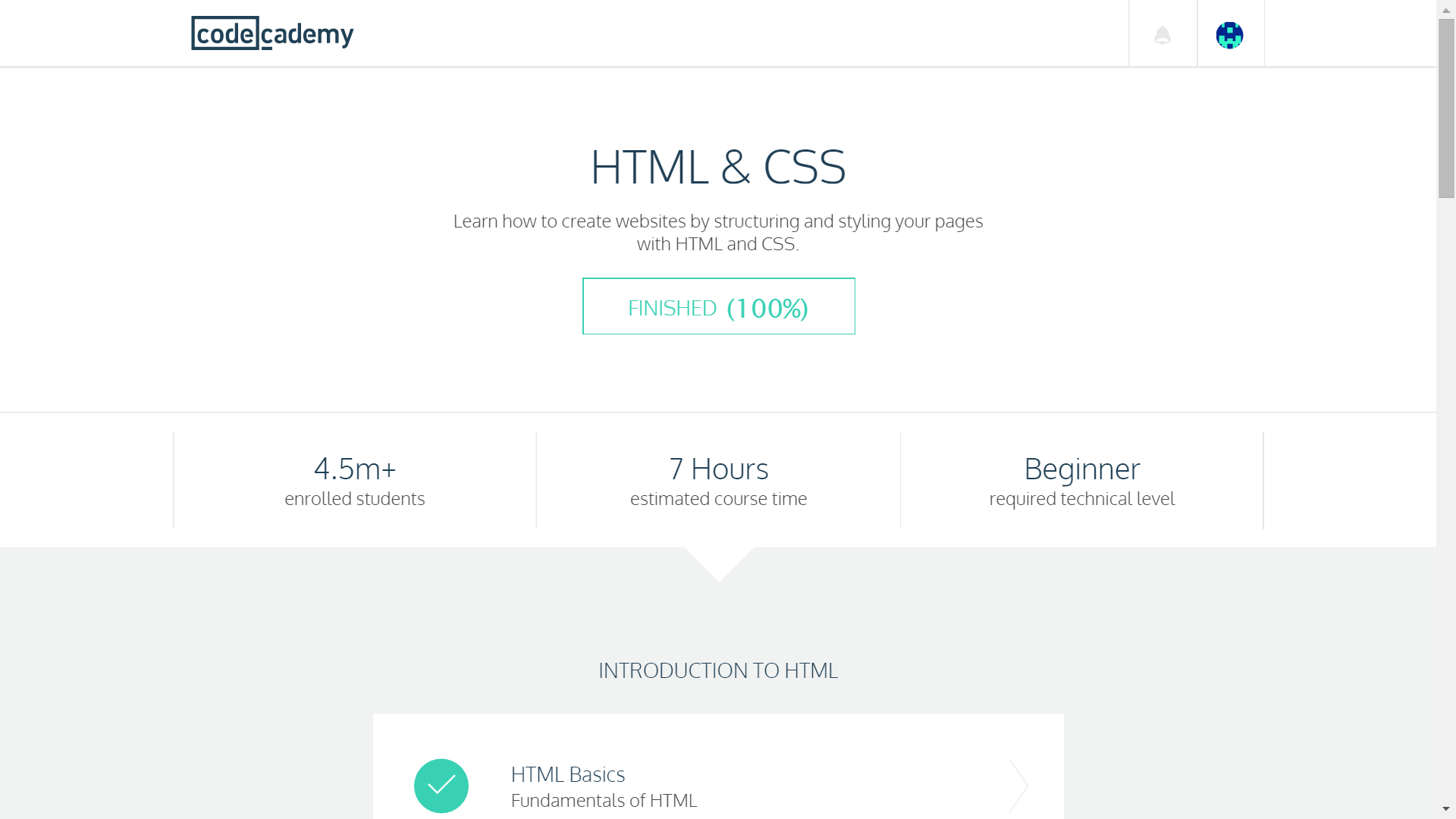
After completing the HTML and CSS portions of Rob Percival’s Udemy course, I felt like I could benefit from a little more practice. I started CodeAcademy’s course about 2 weeks ago and just finished. I feel pretty comfortable with reading CSS and HTML now. I am also pretty confident that I can start working on my personal site soon. I would really like to learn Bootstrap first and use that, so I will probably hold off a little longer.</p>

<h2 id="next-goal">Next Goal</h2>

<p>My next goal is learn Javascript. After seeing how I felt going through HTML/CSS, I made a decision. I am going to progress through CodeAcademy’s Javascript course at the same time I am going through the Udemy coursework. Hopefully this extra practice and different perspective will help me grasp it better. I am very excited to be getting into something that is closer to actual programming. (HTML is markup, CSS is design, etc. I enjoyed learning these, but I really enjoy back-end more.)</p>

<p>Wish me luck!
Bryon</p>]]></content><author><name>bmreverb</name></author><category term="Uncategorised" /><category term="coding" /><category term="css" /><category term="html" /><summary type="html"><![CDATA[After completing the HTML and CSS portions of Rob Percival’s Udemy course, I felt like I could benefit from a little more practice. I started CodeAcademy’s course about 2 weeks ago and just finished. I feel pretty comfortable with reading CSS and HTML now. I am also pretty confident that I can start working on my personal site soon. I would really like to learn Bootstrap first and use that, so I will probably hold off a little longer.]]></summary></entry></feed>